- Add an experimental parser using the tree-sitter grammar shared with
shackle, enabled by setting the
MZN_TREE_SITTER_PARSERenvironment variable. Syntax that is not yet supported, such asclassdeclarations and lambdas, is rejected by name rather than as a generic syntax error. Data files are read with a separate, stricter grammar that accepts data, not all MiniZinc expressions. A warning is issued for invalid data, but will not be accepted in the future. - Harden how external FlatZinc solvers are launched. On POSIX, the solver
is now started with
posix_spawnin its own process group, using close-on-exec pipes and full error checking. On Windows, the solver inherits only the three standard I/O handles (instead of every inheritable handle) and is placed in a kill-on-close job object, so it is reliably terminated together with MiniZinc. Several descriptor and handle leaks were fixed in the process. - Extend the Xpress solver interface with support for lazy constraints,
lexicographic multiple objectives (via the
goal_hierarchyannotation), and user cuts, and enable quadratic and bilinear constraints. - Make built-in Gecode solver interface handle restart annotations and statistics output.
- Greatly reduce the memory used by two-pass compilation (
--two-pass,-O2and above). The paths that identify variables between passes were stored as one string per variable, each spelling out the file name of every frame on the flattening call stack, and held several times over. They are now an interned tree of shared frames, and the text is only built when--keep-pathsor--output-pathsasks for it. Where an expression has picked up more than one path, the deepest one is now kept. Previously the textually longest was kept, which could prefer a shallower path that happened to run through longer file or function names (issue 1029). - Plus 10+ bugfixes!
Downloads
Official binary packages are provided for Windows, macOS and Linux.
These contain MiniZinc 2.10.1, the MiniZinc IDE 2.10.1, as well as several state of the art solvers.
For detailed installation instructions, see the documentation.
Both the compiler tool chain and the IDE are available as free and open source software.
Have a look at our License Information page for the details.
The MiniZinc compiler and IDE
The compiler is the heart of the MiniZinc tool chain. It translates constraint models into FlatZinc, a language that is understood by a wide range of solvers.
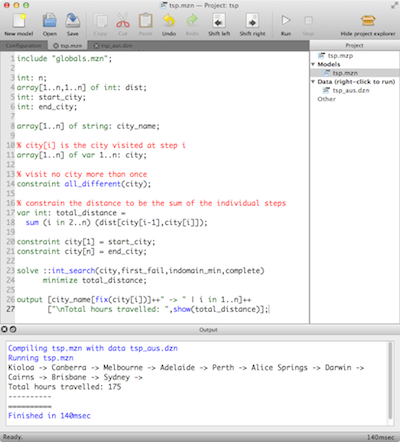
MiniZinc comes with a simple Integrated Development Environment, the MiniZinc IDE, which makes it easy to develop and run constraint models.
Solvers
A number of solvers are included in the official binary packages:
MiniZinc can also interface with the following solvers if installed:
Additionally, many other compatible solvers can be installed, including:
Note that if you build MiniZinc from source, you will have to install any desired solvers yourself.
Reporting issues
We are grateful for feedback on MiniZinc, including bug reports, feature requests and ideas for improvements.
For general discussions about MiniZinc, please use the discussion forum.
To report an issue, please use the following issue trackers:
Releases
The latest release of MiniZinc is version 2.10.1, released 31 August 2026.
Previous releases
- MiniZinc 2.10.0 (released 23 July 2026, change log)
- MiniZinc 2.9.7 (released 30 April 2026, change log)
- MiniZinc 2.9.6 (released 24 April 2026, change log)
- MiniZinc 2.9.5 (released 23 January 2026, change log)
- MiniZinc 2.9.4 (released 29 September 2025, change log)
- MiniZinc 2.9.3 (released 23 May 2025, change log)
- MiniZinc 2.9.2 (released 6 March 2025, change log)
- MiniZinc 2.9.1 (released 3 March 2025, change log)
- MiniZinc 2.9.0 (released 11 February 2025, change log)
- MiniZinc 2.8.7 (released 2 October 2024, change log)
- MiniZinc 2.8.6 (released 25 September 2024, change log)
- MiniZinc 2.8.5 (released 3 June 2024, change log)
- MiniZinc 2.8.4 (released 10 May 2024, change log)
- MiniZinc 2.8.3 (released 1 February 2024, change log)
- MiniZinc 2.8.2 (released 15 December 2023, change log)
- MiniZinc 2.8.1 (released 27 November 2023, change log)
- MiniZinc 2.8.0 (released 16 November 2023, change log)
- MiniZinc 2.7.6 (released 20 June 2023, change log)
- MiniZinc 2.7.5 (released 7 June 2023, change log)
- MiniZinc 2.7.4 (released 11 May 2023, change log)
- MiniZinc 2.7.3 (released 20 April 2023, change log)
- MiniZinc 2.7.2 (released 5 April 2023, change log)
- MiniZinc 2.7.1 (released 31 March 2023, change log)
- MiniZinc 2.7.0 (released 23 February 2023, change log)